Introduction
For business owners, understanding how to protect intellectual property can be a game-changer for growth and competitive advantage. Patent and copyright laws form the backbone of intellectual property protection, each catering to different types of assets and offering unique legal benefits. This guide explores the fundamentals of patent and copyright laws, highlighting their defining features and legal frameworks. It clarifies the key differences in scope, duration, and rights, helping businesses understand what fits under each protection. The article then dives into the various types of patents and copyright protections available, explaining how they can be strategically leveraged. Finally, it examines the critical role these laws play in fostering innovation and safeguarding creative expression, empowering business owners to make informed decisions that secure their intellectual property assets.
Tables of Contents
Chapter 1: Fundamentals of Patent and Copyright Laws: Definitions and Legal Framework
- Technological Innovation and Legal Protections: The Core of Patent Law’s Application
- Economic Incentives and Public Benefits Embedded in Patent and Copyright Laws
- Global Dimensions and Geopolitical Dynamics in Patent and Copyright Law
- Balancing Innovation and Access: Societal Impact and Enforcement in Patent and Copyright Law
Chapter 2: Differences Between Patent and Copyright Laws: Scope, Duration, and Rights
- Exploring the Distinct Boundaries of Patent and Copyright Protections
- Navigating Duration Differences: How Patent and Copyright Terms Shape Protection and Innovation
- Exclusive Rights and Protections: Understanding Patent and Copyright Entitlements
- Understanding the Core Conceptual and Procedural Distinctions Between Patents and Copyrights
Chapter 3: Types of Patents and Copyright Protections in Patent and Copyright Laws
- Exploring Technological and Creative Boundaries in Patent and Copyright Protections
- Economic Influence and Market Significance of Patent and Copyright Protections
- Geopolitical Forces Shaping Patent and Copyright Protections Worldwide
- Balancing Innovation and Access: Societal Impacts of Patent and Copyright Protections
Chapter 4: How Patent and Copyright Laws Fuel Innovation and Creative Advancement
- Patents as Catalysts: Driving Technological Innovation and Economic Growth
- How Copyrights Inspire Creativity and Patents Drive Technological Progress
- Navigating the Delicate Balance Between Exclusive Rights and Public Access in Intellectual Property
- Intellectual Property Foundations: Unlocking Innovation and Creative Expression Through Legal Protection
Chapter 1: Fundamentals of Patent and Copyright Laws: Definitions and Legal Framework

1. Technological Innovation and Legal Protections: The Core of Patent Law’s Application
Patent law safeguards technological innovation by granting inventors exclusive rights to exclude others from making, using, or selling their inventions for a limited term, generally 20 years. To qualify, inventions must be novel, useful, and non-obvious, covering processes, machines, compositions, or improvements. This protection fosters technological progress by balancing inventor rights with public knowledge through full disclosure requirements in patent applications. The legal process involves a thorough examination to ensure originality and functionality, enforcing exclusivity that incentivizes research and commercial investment.
Unlike copyrights, which protect creative expression, patent law focuses on the functional and technical aspects of inventions. This makes it essential for technology-driven industries where innovation fuels growth and competitive advantage. Furthermore, patents serve as valuable assets, often leveraged in licensing and financing, highlighting their economic and strategic significance. Understanding patent law’s technological foundation is crucial for navigating innovation’s legal landscape and maximizing intellectual property rights.
For deeper insights into related intellectual property protections, exploring copyright information for books offers valuable complementary knowledge.
2. Economic Incentives and Public Benefits Embedded in Patent and Copyright Laws
Patent and copyright laws establish exclusive rights that incentivize innovation and creativity by offering economic rewards to inventors and creators.
Patent law grants a temporary monopoly—usually 20 years—on inventions and technological advances, encouraging investment in research and development. This exclusivity enables inventors to recover costs and profit from their work while fostering further scientific progress. For example, in pharmaceuticals, patents are crucial for offsetting costly, lengthy drug development processes.
Conversely, copyright law protects original expressions—such as literary and artistic works—by providing creators control over reproduction, distribution, and public performance. This protection stimulates cultural growth and the creative economy by allowing authors and artists to monetize their efforts. Although copyright does not extend to ideas themselves, securing rights over their expression ensures ongoing incentive.
Both laws strike a careful balance: exclusivity is limited in duration to eventually serve the public interest. After patents expire, generic products enter the market; copyright permits exceptions like fair use. This framework encourages continuous innovation and cultural enrichment while ensuring eventual widespread access.
For a broader understanding of how copyright supports creative business interests, see copyright definition economics business.
3. Global Dimensions and Geopolitical Dynamics in Patent and Copyright Law
Patent and copyright laws function within complex international systems shaped by geopolitical forces and multilateral agreements. Patent rights are territorial, granting protection only within the issuing country or region, necessitating inventors to seek patents separately in each jurisdiction. Copyright, while also nationally grounded, benefits from international treaties that streamline protection across borders. The World Trade Organization’s TRIPS Agreement establishes baseline standards for intellectual property (IP) protection, compelling member nations to harmonize aspects of patent and copyright law. Complementing TRIPS, the World Intellectual Property Organization administers treaties such as the Patent Cooperation Treaty and the WIPO Copyright Treaty, which facilitate international registration and enforcement. However, IP enforcement still varies widely due to differences in legal systems, economic priorities, and political agendas. These variations often reflect broader trade interests or public policy goals, such as ensuring access to essential medicines or balancing innovation incentives with cultural preservation. The global nature of digital technology and artificial intelligence also challenges existing frameworks, demanding enhanced international cooperation to manage emerging intellectual property issues. For deeper insights on copyright’s role in business contexts, exploring copyright language for business owners can provide practical understanding of navigating these complex legal environments.
4. Balancing Innovation and Access: Societal Impact and Enforcement in Patent and Copyright Law
Patent and copyright laws create a delicate balance between rewarding creators and serving the public interest. By granting inventors exclusive rights for a limited time, patent laws encourage technical innovation and disclosure that ultimately advances society. Similarly, copyright law protects original creative expressions, ensuring authors can benefit financially while their works inspire cultural growth. These protections foster economic development by allowing creators to monetize their innovations and artistic outputs, stimulating further advancements.
Legal enforcement empowers patent holders to prevent unauthorized production or sale of inventions, while copyright owners control reproduction and distribution of their works. This incentivizes investment in research, development, and creative endeavors, but protection terms are limited to avoid permanent monopolies. After expiration, inventions and creative works enter the public domain, becoming accessible to all for use and improvement. Fair use doctrines provide additional flexibility in copyright law, allowing certain uses without permission to promote education and criticism.
Together, these frameworks strive to promote innovation and creativity while ensuring knowledge and culture remain available to society, underpinning progress through a balanced system of rights and access. For a detailed exploration of copyright’s role in public access, see this guide on copyright law and public domain.
Chapter 2: Differences Between Patent and Copyright Laws: Scope, Duration, and Rights

1. Exploring the Distinct Boundaries of Patent and Copyright Protections
Patents and copyrights serve as two pillars of intellectual property, yet they protect fundamentally different creations. Patents safeguard inventions—covering new products, processes, or designs—by granting inventors exclusive rights to prevent others from making, using, or selling the patented innovation. This exclusivity typically lasts 20 years from the filing date, encouraging technological advancement by limiting unauthorized exploitation temporarily. In contrast, copyrights protect the specific expression of original creative works such as literature, music, and art, with protection extending for the author’s lifetime plus 70 years. Copyright does not shield ideas or methods themselves but secures the unique manifestation fixed in a tangible medium. The enforcement of these rights also diverges: patent holders assert control over functional uses of inventions, while copyright holders control reproduction, distribution, and public display of creative works. Moreover, doctrines like patent exhaustion and first sale define how subsequent buyers may use patented products or copyrighted copies, highlighting nuanced legal frameworks governing each area. This distinction in scope, duration, and rights illustrates how these legal protections complement innovation and creativity uniquely. For deeper insight, see copyright definition and its business implications.
2. Navigating Duration Differences: How Patent and Copyright Terms Shape Protection and Innovation
The duration of protection fundamentally distinguishes patent and copyright laws, influencing how inventions and creative works are safeguarded over time. Patent protection grants inventors exclusive rights typically lasting 20 years from the filing date, fostering innovation by allowing temporary monopoly over functional ideas. This finite term reflects a balance between rewarding inventors and eventually enabling public access to technologies. In contrast, copyright endures far longer, usually spanning the lifetime of the author plus 70 years, reflecting the value placed on cultural and artistic expressions. This extended term ensures ongoing control over literary, musical, and artistic creations, providing long-term incentives for creative endeavors. Unlike patents, copyrights do not require formal registration, although registration can strengthen enforcement. The differing durations highlight each law’s purpose: patents encourage technological progress through limited exclusivity, while copyrights promote sustained cultural enrichment by protecting expressive works for generations. Understanding these temporal distinctions clarifies how intellectual property laws complement each other in supporting innovation and creativity. For more on copyright scope and protection strategies, see copyright information example for business.
3. Exclusive Rights and Protections: Understanding Patent and Copyright Entitlements
Patent and copyright laws grant distinct exclusive rights aligned with their unique purposes. Patents provide inventors with the power to prevent others from making, using, selling, or importing their inventions for typically 20 years from filing. This exclusionary right centers on functional and technical innovations, allowing inventors to commercialize or license their inventions exclusively. However, holding a patent does not necessarily permit the inventor to use the invention if other legal restrictions apply.
In contrast, copyrights confer multiple exclusive rights over the specific expression of creative works—such as literary texts, music, or artwork—rather than the underlying ideas. Copyright holders can reproduce, distribute, publicly perform, and display their works, along with the right to create derivative works. The duration extends much longer, usually for the author’s lifetime plus 70 years, fostering long-term artistic control and dissemination.
Both legal regimes recognize limitations: patents exclude abstract ideas and natural laws and are territorial, while copyrights include doctrines like fair use to balance public interests. Understanding these exclusive rights helps creators and businesses protect their innovations and creative expressions effectively. For a deeper dive into copyright scope and protections, see copyright distribution rights.
4. Understanding the Core Conceptual and Procedural Distinctions Between Patents and Copyrights
The fundamental differences between patent and copyright laws lie in their conceptual scope, duration of protection, and the rights they confer. Patents safeguard inventions and innovative processes by granting inventors exclusive rights to their functional and technical creations. These rights typically last 20 years and require a rigorous application and examination process, ensuring that the invention is novel, useful, and non-obvious. Conversely, copyright protects the original expression of ideas fixed in a tangible medium, such as literature, music, and art. Unlike patents, copyrights do not protect ideas themselves but the specific form of expression, lasting for the author’s lifetime plus 70 years in most cases. Copyright protection arises automatically upon creation, with registration optional yet beneficial for enforcement. While patent holders can exclude others from making, using, or selling their inventions without consent, copyright owners control reproduction, distribution, and adaptation of their works. This distinction highlights patents’ focus on functional innovation and copyrights’ emphasis on creative expression, anchored within different procedural frameworks tailored to their unique protection goals. For further insight into copyright’s nuances, see detailed explanations on copyright language for business owners.
Chapter 3: Types of Patents and Copyright Protections in Patent and Copyright Laws
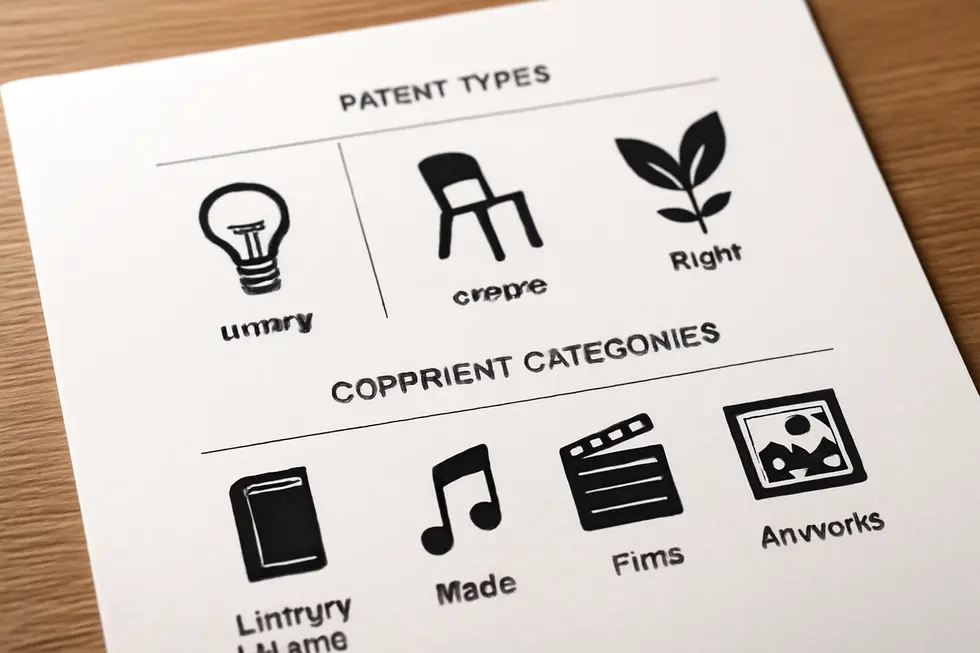
1. Exploring Technological and Creative Boundaries in Patent and Copyright Protections
Patents and copyrights serve unique roles in protecting technological advancements and creative expressions, reflecting distinct dimensions of innovation. Patents focus on inventions with practical applications such as machines, processes, and chemical compositions. This includes utility patents that protect how an invention works, requiring detailed technical disclosures so others skilled in the field can understand and reproduce it. Design patents safeguard the visual appearance of products without covering their functionality, while plant patents protect new, asexually reproduced plant varieties. In contrast, copyrights shield original creative content fixed in a tangible medium—like literary works, music, and software code—emphasizing expression over functional ideas. Copyright does not cover inventions or processes but rather the unique way ideas are presented. For example, a cutting-edge robotic device might be covered by multiple protections: a utility patent for its mechanical system, a design patent for its unique exterior, and copyright for its controlling software code. This technological and creative interplay highlights how intellectual property laws complement each other, addressing diverse facets of innovation. For further insights on copyright fundamentals, see copyright information for books.
2. Economic Influence and Market Significance of Patent and Copyright Protections
Patents and copyrights serve as powerful economic tools that stimulate innovation and shape market dynamics. Utility, design, and plant patents grant inventors exclusive rights—typically for 20 years—providing a crucial incentive to invest in research and development. These protections create market exclusivity, enabling businesses to command premium pricing, block competitors, and leverage licensing deals that generate ongoing revenue. Patents function as strategic assets, influencing product differentiation and long-term growth strategies, though their costs and potential for overly broad claims can present challenges.
Meanwhile, copyrights safeguard original creative works such as literature, music, and software by protecting specific expressions rather than ideas. They empower creators and companies to monetize content through sales, royalties, and licensing, contributing to brand differentiation and customer loyalty. Copyrighted materials play a vital role in enhancing brand identity and expanding global reach by reducing risks of unauthorized use.
Together, patents and copyrights are essential in fostering economic growth and competitive advantage. Their distinct protections support innovation and creativity, fueling investments and strategic positioning across domestic and international markets. This synergy underscores their critical function within intellectual property law.
For deeper insight into how copyright supports businesses in protecting their creative content, see copyright information example business.
3. Geopolitical Forces Shaping Patent and Copyright Protections Worldwide
Geopolitical considerations profoundly influence the landscape of patent and copyright protections, intertwining national interests with intellectual property (IP) strategies. Nations strategically use patent laws not only to protect inventions but also to assert technological leadership, shaping international standards that govern innovation. This positioning grants them leverage in global markets, affecting everything from product compatibility to regulatory approvals, thereby influencing economic and security priorities. Similarly, copyright protections serve as tools to safeguard cultural assets and bolster domestic creative industries amid complex international relations. The enforcement of copyright laws often reflects geopolitical tensions, particularly as digital technologies and AI challenge existing frameworks. International agreements like TRIPS exemplify this interplay by harmonizing IP protections while allowing countries to employ flexibilities—such as compulsory licensing—that balance corporate rights and public welfare. Understanding how geopolitical dynamics dictate the scope, enforcement, and strategic use of patent and copyright laws is essential for navigating the global IP environment. For further insights into copyright protections and business considerations, exploring their intersection with international policies reveals evolving challenges and opportunities.
4. Balancing Innovation and Access: Societal Impacts of Patent and Copyright Protections
Patent and copyright protections serve crucial societal roles by incentivizing innovation and creativity while posing challenges related to access and equity. Patents grant inventors exclusive rights, encouraging investments in sectors like pharmaceuticals and technology. However, these protections can restrict public access to essential inventions, such as life-saving drugs, raising ethical concerns about affordability and fairness. Copyrights safeguard creative works, motivating artistic and literary contributions, yet rigid enforcement can limit the availability of cultural and educational content. Both patent and copyright laws influence economic dynamics by fostering revenue generation and investment but also risk creating monopolies that may stifle competition and knowledge diffusion. Legal frameworks must address emerging challenges, including AI-generated works and controversial business-method patents, to remain effective and fair. The tension between protecting creators’ rights and ensuring public benefit requires careful policy balance, acknowledging the importance of ethical considerations and technological change. For more details on the economic and business perspectives of copyright, see an insightful overview of copyright definition in economics for business.
Chapter 4: How Patent and Copyright Laws Fuel Innovation and Creative Advancement

1. Patents as Catalysts: Driving Technological Innovation and Economic Growth
Patents empower inventors with exclusive rights that stimulate technological progress and economic investment. By granting inventors the ability to exclude others from manufacturing or using their inventions for a defined period, patents provide a critical incentive to innovate. This protection encourages companies to invest in costly research and development, confident they can recoup these efforts through commercialization or licensing. The patent system fosters collaboration, as licensing agreements facilitate technology transfer, accelerating the adoption of breakthrough innovations across industries such as renewable energy and artificial intelligence.
Moreover, patents align private incentives with larger societal goals by safeguarding environmentally sustainable technologies. While patent exclusivity is temporary, it balances private benefit with eventual public access to knowledge. This framework encourages continuous advancement while supporting competitive markets. Universities and research institutions often leverage patents strategically to promote innovation ecosystems where discoveries are both protected and shared.
Understanding patents’ role in this dynamic ecosystem reveals how they fuel economic growth and technological breakthroughs, integral to the broader landscape of intellectual property protection alongside copyright. For further insights on patent-driven innovation and commercialization, exploring the role of patent licensing provides valuable context.
2. How Copyrights Inspire Creativity and Patents Drive Technological Progress
Patent and copyright laws serve as twin pillars supporting innovation and creative expression by granting creators exclusive rights that encourage investment and artistic endeavor. Copyright protection applies to the original expression of ideas fixed in tangible forms—such as literature, music, and art—without guarding the underlying ideas themselves. This allows authors and artists to control and monetize their works, securing financial incentives while eventually contributing to society when copyrights expire, typically after the life of the author plus 70 years. Conversely, patent law safeguards novel and useful inventions or processes, generally for 20 years, motivating inventors to undertake costly research and development by ensuring temporary exclusivity in the marketplace. Together, these legal frameworks balance private incentives with public benefits: copyrights promote cultural growth by protecting creative works, while patents accelerate technological advancement by protecting functional innovations. This dual protection enriches both our cultural heritage and technological landscape, fostering economic growth and continuous creative and scientific breakthroughs. For more insights on copyright’s role in cultural accessibility, see copyright law and the public domain.
3. Navigating the Delicate Balance Between Exclusive Rights and Public Access in Intellectual Property
Patent and copyright laws create a necessary equilibrium between granting exclusive rights and maintaining public access, which drives innovation and creative expression. Patents offer inventors a temporary monopoly—typically 20 years—to protect new inventions, encouraging investment and technological advancement. This exclusivity motivates disclosure of knowledge, enabling others to build on these inventions. Conversely, overly broad or lengthy patents risk hindering competition and slowing progress.
Copyright protects authors by securing rights to their original creative works for the life of the creator plus 70 years, fostering artistic development. However, excessive restrictions can limit cultural exchange and the evolution of derivative works. Legal safeguards like licensing agreements allow rights holders to permit use under negotiated terms, fostering collaboration and dissemination.
Fair use provisions enable limited use without permission for purposes like education and commentary, preserving transformative creativity while respecting owners’ interests. Additionally, mechanisms such as open-source and public domain materials promote accessibility and further innovation.
Emerging technologies, especially artificial intelligence, challenge existing frameworks by unsettling traditional notions of authorship and ownership. Adapting intellectual property law to these advancements remains essential to uphold this balance, promoting economic growth and creative vitality.
For more insight on how copyrights foster creativity and public access, refer to copyright law and public domain resources.
4. Intellectual Property Foundations: Unlocking Innovation and Creative Expression Through Legal Protection
Intellectual property laws are vital frameworks that encourage both innovation and creative expression by granting creators exclusive rights for a limited time. This system balances private interests with public benefit, incentivizing investment in new inventions and original works while eventually enriching the public domain. Patents protect technological advances by offering inventors exclusive control over useful, novel, and non-obvious inventions for up to 20 years, fostering commercial development and knowledge sharing. Copyrights safeguard artistic and literary works, securing creators rights to reproduce, distribute, and display their expressions for the life of the author plus 70 years, thus nurturing cultural growth. These protections stem from constitutional authority that aims to promote progress in science and the arts by rewarding ingenuity without permanently limiting access. Although distinct, patents and copyrights share the purpose of empowering creators to control and benefit from their labor. Carefully calibrated IP policy must maintain this balance, ensuring rights encourage creativity and innovation without stifling future advances or restricting public access to knowledge and culture. For more details on copyright protection strategies, see copyright information for books.
Final thoughts
Understanding patent and copyright laws is essential for business owners seeking to protect their innovations and creative assets effectively. These laws provide distinct but complementary protections that empower businesses to secure exclusive rights, maintain competitive advantage, and foster an environment of growth. Patents guard the functional and technical innovations critical to product development, while copyrights safeguard artistic and literary works that enrich brand identity and cultural value. By grasping the legal frameworks, scope, and types of protections available, business leaders can make strategic decisions that maximize the value of their intellectual property. These protections not only defend against unauthorized use but also incentivize ongoing innovation and creativity—two pillars of sustainable business success.
Your IP is the foundation of your success – let’s protect it together before it’s too late. We can’t wait to help you turn your ideas into legally secured assets.
About us
undefined